
November 6, 2026
New Importer of Record Requirements: After January 5, a U.S. Address Won't Make You a U.S. Importer
Executive Summary
CBP's new importer of record rule, an interim final rule published November 6, 2026 under Executive Order 14411, takes effect January 5, 2027. From that date, foreign importers of record without CTPAT validation must clear goods through a CTPAT-validated customs broker. U.S. importers of record must meet new citizenship, ownership, or property tests and declare that status on every entry. Foreign-owned U.S. subsidiaries and companies buying DDP from overseas suppliers should check their status now.
Key Takeaways
- Foreign IORs without CTPAT validation must use a CTPAT-validated broker from January 5, 2027.
- A U.S. charter isn't enough anymore. A company needs at least 51% U.S. citizen or permanent resident beneficial owners who control it, or significant unencumbered U.S. real property it owns directly.
- Every entry will declare U.S. IOR status, and brokers have to see your records before they can say yes.
- DDP buyers inherit the risk when an overseas supplier's broker isn't validated.
- The 60-day window holds three federal holidays and December sailings that land after the deadline.
Intro
September's crackdown on inaccurate importer records was about proving your company is who it claims to be. On November 6, CBP followed up with a more uncomfortable question: is your company actually a U.S. importer, or does it just have a Delaware incorporation and an American mailing address?
Turns out, Customs is getting considerably less impressed by the paperwork.
Under the new importer of record requirements, taking effect January 5, 2027, foreign importers without CTPAT validation must clear shipments through a broker that has it. CBP estimates roughly 60,000 foreign importers currently meet neither condition, while just 643 of the country's approximately 3,100 active customs brokers are validated.
That's a potentially enormous rush for a relatively small pool of brokers, conveniently scheduled around the holidays. And the consequences could extend well beyond an administrative headache if your next shipment arrives before you've sorted things out.
We'll explain how CBP now distinguishes foreign importers from U.S. importers, what changes on January 5, and what your business should address before Customs makes that distinction for you.
Does Your Company Still Count as a U.S. Importer of Record?
Possibly, but a U.S. incorporation certificate no longer settles the question. Under the new 19 CFR 110.2, CBP wants to know who actually controls your company and what it owns on American soil.
Individuals have it easy: U.S. citizens and permanent residents qualify. Businesses must be organized under U.S. law, located here, and satisfy at least one of two tests at all times:
- Ownership: At least 51% of beneficial owners by U.S. citizens or lawful permanent residents who control the entity.
- Property: The company directly owns significant unencumbered U.S. real estate. CBP hasn't defined what “significant” means in dollars.
CBP considers anyone with at least 25% ownership or substantial control a beneficial owner, and follows the ownership chain to the actual people behind the business.
Fail both tests, and you're a foreign importer, regardless of what your Delaware paperwork says. An overseas parent and leased U.S. facilities should prompt a closer look.
What Happens to Foreign Importers of Record on January 5?
January 5 is when your CTPAT status starts determining how you can get freight through Customs. Foreign importers will have two options:
- Already CTPAT validated? You can continue filing your own entries or use any licensed customs broker.
- Not validated? You'll need a CTPAT-validated broker to file for you. If you're neither the owner nor purchaser of the goods, that broker must also serve as importer of record.
The rule applies to all formal entries and informal entry types 11, 12, and 13. CBP stopped short of the executive order's proposed informal-entry ban, although it's keeping that option on the table.
If you’re hoping to get validated before January, don't bank on it. Only nonresident Canadian importers qualify among foreign IORs, and validation can take well beyond the deadline.
Your broker arrangements deserve attention now.
What If Your Overseas Supplier Is the Importer of Record?
Your supplier has to meet the new requirements, and if it doesn't, your shipment could be stuck at Customs. The fact that someone else handles the import doesn't make the delivery delay any less yours.
Under a delivered duty paid (DDP) arrangement, your overseas supplier typically handles U.S. customs clearance and pays the duties. Starting January 5, that supplier must either be CTPAT validated or use a customs broker that is.
Ask your DDP suppliers who's filing their U.S. entries and get written confirmation of the broker's CTPAT status. Don't settle for "our logistics partner handles that."
If the broker isn't validated, your supplier needs to switch to one that is. You could also take over as importer of record, provided you qualify. However, that puts Customs compliance and duty liability on your plate.
What Will Your Customs Broker Ask You For?
Proof that you're who your entries say you are. From January 5, every entry answers a new yes-or-no question on CBP Forms 3461 and 7501: Is the importer a U.S. IOR?
Before your broker can say yes, new 19 CFR 111.29(a)(2) requires it to review records such as:
- Proof of U.S. citizenship or permanent residency
- Corporate charters
- Financial statements
- Purchase receipts and documents of title
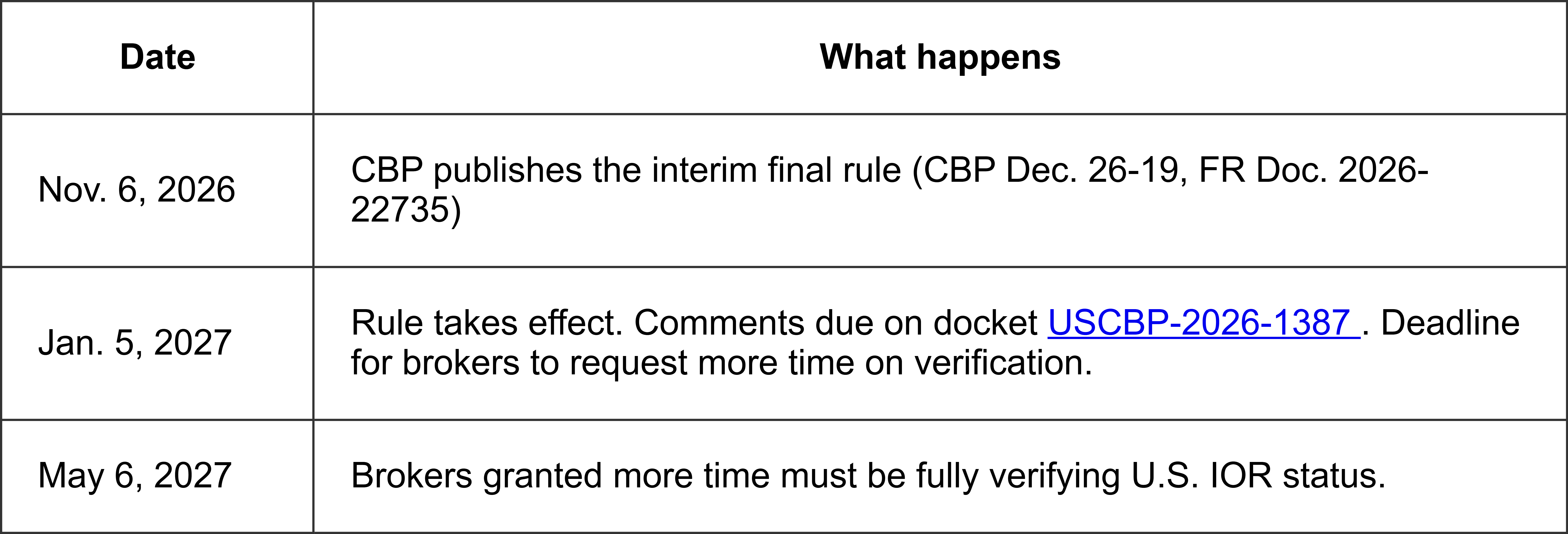
If they show you're not, a broker without CTPAT validation has to stop filing for you. Brokers can apply for extra time to verify, until May 6, 2027, but the declaration still starts January 5.
Expect your broker to be strict, because CBP can now penalize broker errors under 19 U.S.C. 1592, up to the goods' domestic value, instead of mostly under 1641's $30,000 cap. A wrong declaration can also put you on live entry: duties paid before release.
How Much Time Do You Have?
Less than the calendar says.
The rule takes effect January 5, 2027, 60 days after publication, and Thanksgiving, Christmas, and New Year's all fall inside that window. Most freight sailing from Asia to the East Coast after the first week of December won't arrive until the rule is in force.
How Mallory Alexander Can Help Before January 5
Mallory Alexander International Logistics is a licensed customs broker, CTPAT-validated and in the program since 2006, so we can keep filing for non-validated foreign IORs after January 5. Our brokerage and trade compliance teams can:
- File as your validated broker, with the power of attorney and Form 5106 checks done before your first January entry.
- Review your U.S. IOR status, tracing ownership to the people at the top and keeping the verification file current.
- Check your DDP suppliers and evaluate the compliance responsibilities and potential costs of serving as the importer of record.
- Clean up your importer record so stale Form 5106 data doesn't get your number voided.
Have entries filing after January 5? Contact your Mallory Alexander representative or call 1-800-257-8464. Each one will answer a question CBP has never asked before. Settle your answer before your broker has to type it.
Additional FAQs About the New Importer of Record Rule
Why Is CBP Tightening the Rules for Foreign Importers of Record?
CBP says foreign importers of record are much harder to collect from. It recovered only 3.1% of $1.16 billion in identified revenue losses from foreign IORs, versus 15.2% from U.S. importers. Non-CTPAT foreign IORs also average $34.08 in uncollected bills per entry summary, against $1.21 for validated ones.
How Does CBP Verify U.S. Importer of Record Status?
CBP verifies U.S. importer of record status under 19 CFR 110.2(b) by weighing factors such as principal place of business, physical presence, unencumbered domestic assets, directly owned U.S. real property, sales exceeding cost of goods sold, and capitalization. Bank deposits, Treasuries, and U.S.-located inventory count as assets; receivables don't.
Does Using a CTPAT-Validated Broker Give an Importer CTPAT Benefits?
No. CBP's interim final rule says a foreign importer of record that files through a CTPAT-validated customs broker doesn't inherit CTPAT benefits, such as fewer exams or front-of-line inspections. Those require the importer's own CTPAT membership, and CTPAT's importer category is open only to U.S. and nonresident Canadian importers.
Does the Importer of Record Rule Change Customs Bond Requirements?
No. The interim final rule amends 19 CFR Parts 110, 111, 141, 142, and 171 and leaves CBP's bond regulations in Part 113 alone. Executive Order 14411 also called for tougher bonding for importers, so bond changes could still come through a separate CBP action.
Can Importers Comment on the New Importer of Record Rule?
Yes, through January 5, 2027, on docket USCBP-2026-1387 at regulations.gov. CBP issued the rule as an interim final rule, citing foreign affairs and good cause exceptions to skip advance comment, so it takes effect that day regardless. CBP can still revise it after reviewing comments.
Back
When you sign up for our mailing list, you will receive industry news and the latest supply chain updates.

Please fill out the form and a Mallory Alexander customer service representative will contact you.
Your submission has been received, and our team will reach out soon.